Asparagus: A sure sign spring has sprung!
There is something about asparagus showing up, that makes us feel spring has finally triumphed after its long-drawn-out, turbulent battle with winter. Those bright green spears are one of the clearest and most welcome signs that the season really has turned a corner at last.
After months of different variations of comfort food, freshly picked flavors are back on the menu, and asparagus, with its eye-catching appearance and distinct personality, is a natural for stealing the spotlight.
Often called ‘the food of kings,’ asparagus has a long, distinguished history, spanning over 2,000 years. It was apparently a favorite of Julius Caesar, Thomas Jefferson and King Louis XIV, who was so enamored of asparagus that he had special greenhouses built, to make it available year-round.
Throughout the years it was believed that this classy vegetable was not only good to eat, but could also bestow non-culinary benefits. Early Greeks and Romans apparently thought it could cure toothaches and prevent bee stings, but their belief in its health benefits did turn out to be right. We now know that asparagus is a low calorie, nutrient-dense powerhouse, high in fiber, minerals, antioxidants, and essential nutrients.
It also acts as a natural diuretic, and is favored by bodybuilders as a way to reduce water retention, resulting in a leaner, more toned look on stage. However, that brings us to the unmistakable smell that urine gives off after eating asparagus. That is the result of something found only in this vegetable, called asparagusic acid, which breaks down into sulfur by-products that evaporate as you pee. Sulfur is the chemical that gives rotten eggs and skunk spray their unique, pungent aroma, so it’s an inevitable by-product and a totally harmless, normal bodily reaction. Instead of putting you off, think of it as proof that you are eating a highly nutritious veggie, favored by royalty!
Asparagus is also very versatile. It can be eaten raw; shaved into ribbons and added to salads; paired with pasta or eggs; sliced vertically to serve as dippers; boiled, grilled, fried and steamed. It also makes great soup.
As for how to cook it, that is apparently something that is all too often misunderstood. “Because asparagus is a vegetable, most people tend to overcook it,” explains chef Joseph. “It should be done in two or three minutes, giving it an ‘al dente’ kind of feel, a snap, which is much better than allowing it to get soft. The added texture is definitely a plus.”
His favorite way to cook asparagus is to sauté it in butter or olive oil. “Keep it simple,” he says. “I like to peel the stem if it’s thicker than a number 2 pencil, because it can get woody and fibrous, and it’s best to cut off the white ends where the green begins. And don’t crowd the pan! It’s important to leave enough room to be able to shake it while the asparagus cooks.”
To finish up, Joseph suggests adding more butter, or tamari sauce, seasoning with garlic and adding a side of lemon. “Simplicity really is key,” he emphasizes. “This is a dish that really holds up on its own.”
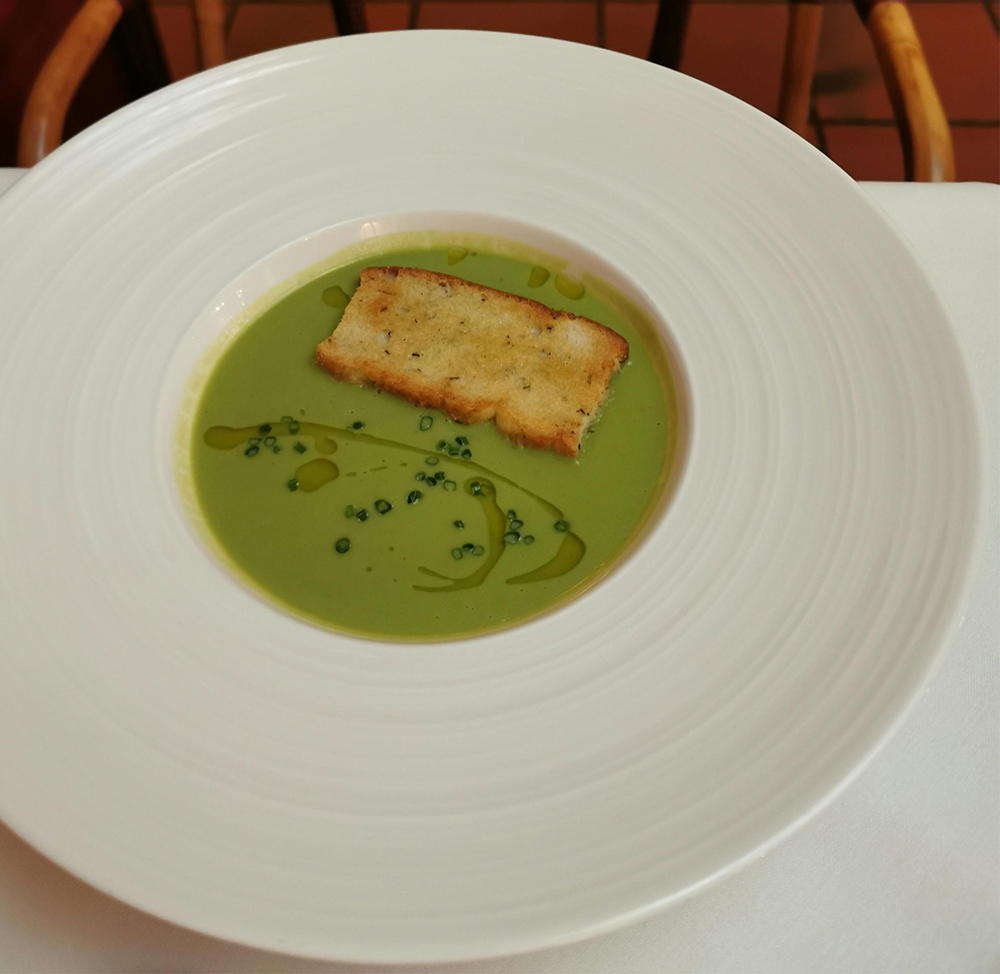
Asparagus Soup
Serves 4
Ingredients
2 lbs asparagus
1 clove garlic
2 tbsp. unsalted butter
2 tbsp. tamari
2 cups chicken stock
2 cups heavy cream
1 tbsp. sliced chives
Method:
Slice asparagus into 1inch pieces. (If asparagus is thicker than #2 pencil, shave the stem.)
Put butter and garlic in medium/large pan on medium/high heat, and cook until brown.
Add asparagus, cook for 2 minutes and deglaze with tamari. Remove from heat.
In separate saucepan, heat chicken stock and cream to simmer, and reduce by half. Add to the asparagus pan and bring to a simmer.
Purée and season with salt and pepper to taste. Garnish with chopped chives and serve. Great also served chilled with a dollop of crème fraîche.